
A piece of Portland in the Cherbourg breakwater
Published 08:10 on 9 Apr 2016
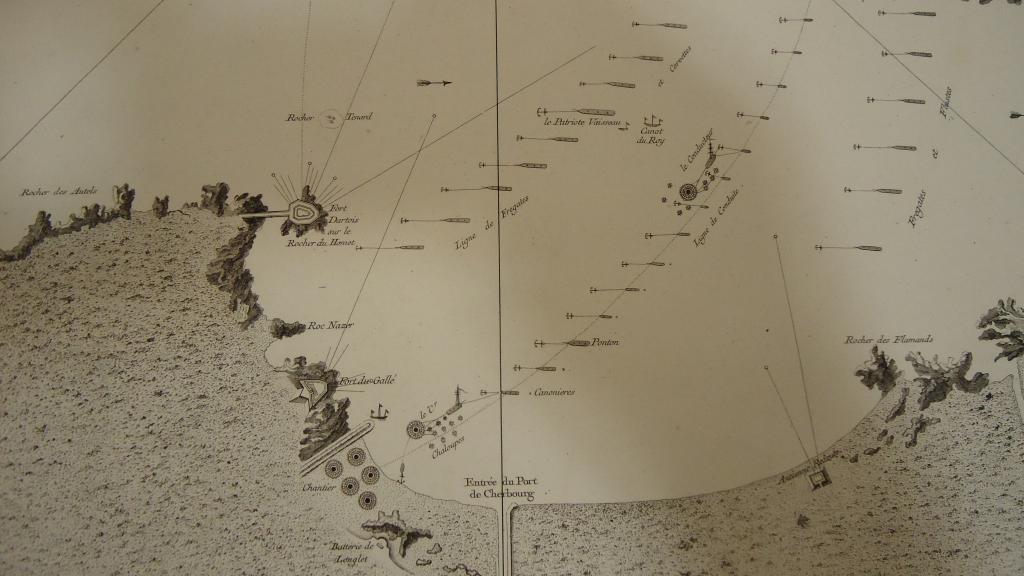
230 years ago, in June 1786, Louis XVI made his only official trip beyond Paris to Cherbourg to witness the sinking of the ninth of the giant wooden cones which made up the first breakwater project there. These huge objects, 20m high, 20m diameter at the top and 50m diameter at the base, were built on the beach at Chantereyne (where the hard standing west of the marina is now), towed out to sea supported by barrels, and sunk by releasing the barrels in a moment of high drama and some danger to those carrying out the operation, and to spectators.To create a suitable and convenient spectacle for the king, the plan was changed so as to sink the cone about 100m to the east of the first cone, where he was installed in comparative safety. This of course made the eastern entrance that much narrower but the subsequent permanent inconvenience to shipping was seen as less important than pleasing the monarch, telling you something about the priorities of engineers in the Ancien R©gime.The success of the towing and sinking, illustrated in the images showing the route from the beach to the breakwater site, was undermined by the death and injury of several workers in an incident which the king witnessed; according to the chief engineer, because a new kind of capstan was being tried out the towing cable was not kept taut, and the cone started to drift with the flood tide until suddenly brought up short with a shock that caused the injuries. The king is recorded as ordering his own doctor to attend the men, as well as granting pensions to their families. The visit continued uninterrupted with naval manoeuvres, visits to the forts being constructed around the rade and dinners ashore.A year later, the king's presence on the first cone was commemorated by a plaque of Portland stone obtained from a local entrepreneur and builder, Jacques-Martin Maurice, whose work can still be seen around Cherbourg, and who also worked for the Queen at Versailles. The stone was set in the middle of a masonry topping to the cone, and became something of a tourist destination; the traveller Arthur Young made a point of having himself rowed out to the cone in 1788, and records the inscription as saying 'Louis XVI Äì on this first cone sunk on 6 June 1784, witnessed the sinking of the cone to the east on 23 June 1786'.The archives also record the names of the casualties of that day: one Jean Pinabel was killed, and his sister was awarded a pension of 150 pounds a year; the four injured received various sums: Jean-Pierre Boursier, 300 pounds; Francois Daumont, 150 pounds; Jean le Bart, 300 pounds; Philippe Jual, 500 pounds. They are part of a grim record of the deaths and injuries caused by the breakwater project, in the building yards, in the quarries and on the boats tipping stone; it is worth noting, though, that compensation was regularly paid at rates similar to those mentioned up until the financial crisis preceding the Revolution. For comparison, a working man might earn between 5 and 10 pounds a week, though the work was tough: it was calculated by the chief engineer that men could theoretically move 42 pounds weight of stone a minute for the duration of a twelve-hour shift.The engraving of the sinking of the cone is a typical product of the industry which sprang up as Cherbourg suddenly became the place to have been, or to have a souvenir of Äì even if it wasn't very accurate. Imagine the cone with the king on is the eastern fort, and the cone is being sunk to the NW, not the east, though that mattered less than the dramatic composition.The cone and its plaque were buried under a great deal more stone after the Revolution, though legend has it that remains of the woodwork of the cones have been seen at exceptionally low tides. It is nevertheless pleasant to think that a piece of local stone played its part in the making of the Cherbourg breakwater...Steve FraserLast updated 15:13 on 28 July 2025